Published March 24, 2026
Visit the Museum of Utah, opening June 27 on the Utah Capitol Complex.
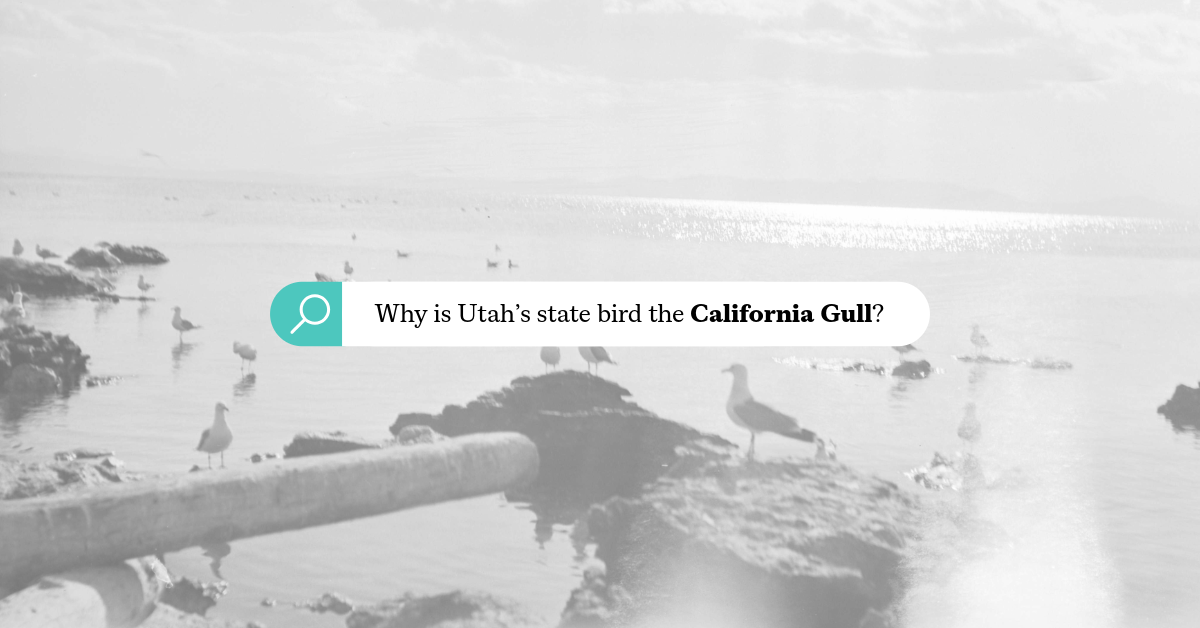
You may be asking yourself: Why would one of Utah’s official symbols be named after a different state? The answer comes from an important event in Utah history known as the “Miracle of the Gulls.”
When the Latter-day Saint pioneers arrived in the Salt Lake Valley in the summer of 1847, they soon got to work planting crops. Their survival depended on a successful harvest in 1848. However, that harvest was threatened when millions of insects swarmed the fields, aggressively devouring the pioneers’ wheat, corn, and vegetables.
The farmers tried everything to stop the insect plague, but nothing worked. Fear of total crop destruction and imminent starvation quickly set in.
A massive flock of birds appeared from the direction of the Great Salt Lake. These California Gulls, a species that breeds around the inland lakes of the American West, came to the rescue. The Gulls descended on the fields and began eating the insects in a feeding frenzy that lasted for weeks, effectively neutralizing the insect plague and saving the pioneers’ harvest. In 1854, George Newbold Lawrence gave the bird the scientific name Larus Californicus. The least he could have done was call it Larus Ate-the-Crickets-cus.
The mythic legacy of the California Gulls was woven into Utah’s cultural identity. In 1913, the Church of Jesus Christ of Latter-day Saints erected the Seagull Monument on Temple Square in Salt Lake City. It’s often cited as the first monument in the world dedicated to a bird. Then in 1955, the Utah State Legislature made it official, formally designating the California Gull as the state bird of Utah to honor its role in saving the early settlers.
So while it might have “California” in its name, the gull’s most famous and heroic moment happened right here in the Salt Lake Valley.
This summer, as the nation reflects on 250 years of American history, Utahns are unwrapping a gift of their own. On Saturday, June 27, the Museum of Utah officially opens its doors. Join us on the Utah Capitol Complex from 9 a.m. to 8 p.m. for a full day of celebration, including live music, food trucks, activities, and more. Be among the first to explore our galleries and immerse yourself in the stories that shape our state. Learn more.